

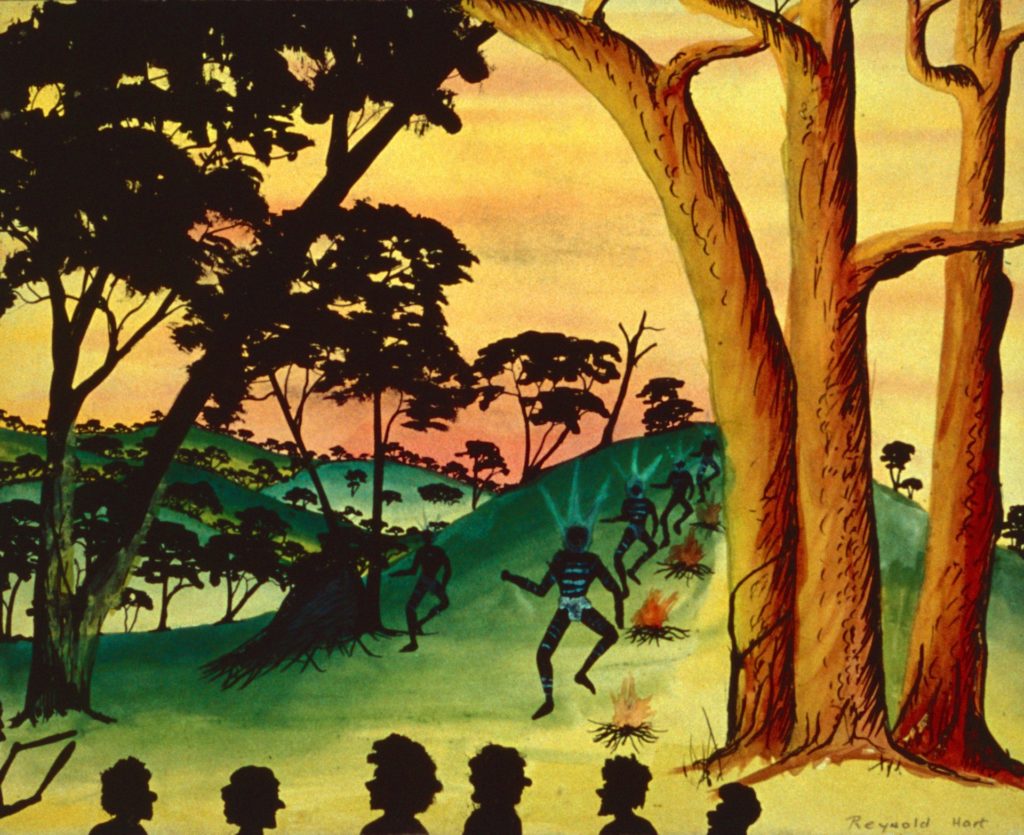
“The boys’ drawings improve over time, and individual styles and preoccupations emerge. The better pupils, about six of the older boys, are now using large sheets of brown, grey or white paper, Noel having observed that a large sheet encourages expression. The boys are depicting sunset and moonlight scenes and showing a liking for drawing dead or ‘skeleton’ trees. They are introducing more birds and animals into their scenes, and the use of movement is growing. They are drawing scenes of Aboriginal men hunting and participating in corroborees, which the boys have witnessed. [1-3]
Charles Crabbe realises that something very important is happening with the Carrolup children’s artworks. He informs Noel during one inspection visit and suggests leaving their style alone, but go on encouraging their interest and observation. The Whites had not fully realised the quality of the art they are seeing until Charles’s comment and the amazed interest of educational authorities. Up until now, they have used the art to facilitate interest and understanding, and to help create a keen sense of observation amongst the children. Whilst it has been part of an overall programme of education and personal development to date, the art is now taking on a life of its own.
The children seem to develop as a group, through a process of mutual interest, discussion, criticism, and support. Whilst they are drawing, the children often keep their pictures hidden from each other. They are very competitive. However, once they complete their piece of work, they compare and discuss the drawing with their fellow artists. Comparisons are made as to how a particular object has been drawn by each of the artists, and animated discussions about perspective, movement and light occur. The boys become prolific and large numbers of drawing soon cover the school’s walls.[4]
It is important to emphasise again that Noel was not teaching the children to draw from his own skills as an artist. He did not paint or draw. However, he no doubt influenced the children, as both Charles Crabbe and he describe:
‘Mr White states that he has never drawn or painted a picture in his life. But he showed particular ability in his methods: He would direct children’s attention to some crudity in drawing, some shadow neglected, some faulty observation and so persuade them to ‘look again’ at the tree or scene. He used the method of displaying several drawings and inviting discussion.’ [2, p. 3]
‘I influenced them to use their eyes in their heads. Sometimes I would take them back and back to the same place, even to the same tree, to see how things looked at different times of the day, in different lights. When they made their first tentative sketches of trees I would encourage them but I would suggest also that we went for another walk to find out more about the way branches grew from trunks and how foliage masses looked against the sky.’ [1, p. 44]
Eventually, Noel realises that the children are noticing more detail than he himself does on the bush walks, commenting on the peculiar patterns of peeling bark, of tree hollows and bumps. During night walks, they notice owls, possums, and other animals, sometimes silhouetted against a full moon. [5] As the children do their drawings on their return to the classroom after their walks, their visual memory is continually improving. The Whites are now feeling out of their depth in many of the discussions arising from the children’s work. Noel later comments that the children have ‘a wonderful sense of observation.’
Barry Loo later said of the development of the children’s art:
‘Mr White later would tell us to take an individual animal and illustrate everything we could about it and in this way we learnt to draw and sketch animals in all positions.
How we, us boys came to do such beautiful art work of scenic and bush scenes is that we spent all our precious hours at school and weekends doing this work and three years of this took our art work to where it is today, and I say all honours are on Mr White who gave us that opportunity to improve our work…’ [6]”
The above is taken from Chapter 6 of my book Connection: Aboriginal Child Artists Captivate Europe. The sources are as follows:
1. M D Miller and F Rutter, Child Artists of the Australian Bush, Australasian Publishing Company in association with George G. Harrap & Co Ltd., 1952, pp. 43-45.
2. Letter from Charles S. Crabbe to Dr Kenneth Stewart Cunningham, 27 June 1951, p. 3.
3 . In the early 1970s, it was assumed that the Carrolup boys’ corroboree drawings were imagined. However, Ross White told John Stanton and his wife Ghislaine in 2012 that he and his father Noel had witnessed ceremonial dances in the bush near Carrolup on six or seven occasions. You can read more about this in John Stanton’s blog post of 11 January 2019, The Corroboree Artworks.
4. The nature of the interactions between the boys when they were doing their drawings is described by Mary Durack Miller and Florence Rutter in their book. Moreover, in their later years, Parnell Dempster and Milton (Mickey) Jackson described to John Stanton how the group of boys interacted. They were competitive whilst doing their drawings, often covering them up so that other children could not see what they were doing. However, once their drawings were completed, they would have an encouraging, collegial discussion whilst they critiqued each other’s work. There was a lot of give and take between the boys as they taught each other how to improve their drawings. It is most likely that these interactions occurred from an early stage of the boys’ artistic development. See film clip about these interactions in John Stanton’s blog of 6 August 2019, Carrolup Child Artists: Competition and Encouragement.
5. In his blog post of 8 January 2019, The Liminality of Dusk, John Stanton describes the boys’ fascination with drawing scenes at dusk. Parnell Dempster described to him how they would watch the falling night through the dormitory windows. This blog post contains a film clip of a dusk at Carrolup in more recent times.
6. Letter from Barry Loo to Florence Rutter, 20 September 1950. In: Florence Rutter, Little Black Fingers, 1950, p. 9.